Sailor Pro Gear Slim Review — Is the Gold Nib Worth It?
Affiliate Disclosure: This site contains affiliate links. If you make a purchase through these links, we may earn a commission at no extra cost to you.
Our Rating: ★★★★½ (4.5/5)
Price Range: $130–$180 (standard colors) | $200–$280 (special editions)
Best for: Writers who want a real gold nib without paying $400+, fountain pen enthusiasts stepping up from the Pilot Metropolitan, and anyone who writes a lot by hand.
Check Price on Amazon →What Is the Sailor Pro Gear Slim?
The Sailor Pro Gear Slim (sometimes called the "PGS" or "Pro Gear Slim Mini") is the smaller, lighter sibling of Sailor's flagship Pro Gear fountain pen. It uses the same 14k gold nib as the full-size Pro Gear, but in a more pocket-friendly body. The result is a pen that fits the price point between the Pilot Metropolitan and a full premium Japanese fountain pen like the Pilot Custom 74 or Platinum 3776.
Sailor has been making fountain pens since 1911, and they're best known for one thing: nibs. The Sailor name is shorthand among fountain pen collectors for some of the finest writing nibs ever made. The Pro Gear Slim is the most accessible way to experience that nib quality without paying $400+ for a full-size King of Pen.
The Slim ships in a wide range of standard colors (black, blue, wine red, pink, yellow, demonstrator) plus rotating special editions. The standard lineup typically costs between $130 and $180, which is the sweet spot for the "first gold nib" purchase.
First Impressions & Build Quality
My Pro Gear Slim arrived in a black box with a Sailor-branded cartridge converter. The pen itself is small. At 123 mm capped, it's noticeably shorter than the Pilot Metropolitan (138 mm) and the Platinum 3776 (140 mm). When capped, it almost disappears in a shirt pocket. When posted, it becomes a perfectly usable full-size pen at 145 mm — though the cap posts quite deep, which makes the balance sit a touch back from the grip.
The body is resin, not metal. That's important: the Pro Gear Slim is a feather-light 17 grams compared to the Metropolitan's 26 grams. Some people love this — long writing sessions don't fatigue your hand. Others miss the heft of a brass body. I'm in the "love" camp. After a three-hour journaling session, my hand didn't ache.
The finish is immaculate. Sailor has decades of experience with resin pens and the polish on the Pro Gear Slim is gorgeous. The cap rings, the Sailor anchor logo, the nib engraving — everything is crisp. The cap closes with a satisfying snap. There's no clip rattle, no wobble, no quality control issues. The only thing that gives it away as a "mid-tier" pen is that the body is resin instead of metal.
The included converter is a Sailor proprietary unit. It works fine and holds a reasonable amount of ink (about 0.5 mL). If you want to use international cartridges or a different converter, you'll need to be careful — Sailor uses a proprietary cartridge/converter fit on most of its modern pens. The good news: Sailor's own converter feels solid and the ink flow with it is consistent.
The 14k Gold Nib: Sailor's Real Magic
This is the reason you buy a Sailor. The 14k gold nib on the Pro Gear Slim is in a completely different class from the steel nib on the Pilot Metropolitan. It's not just that it's gold (gold nibs are softer and more "springy" than steel — that's the basic metallurgy). It's that Sailor's nib engineering is something else.
My test pen came with a Medium (M) nib. Sailor's Medium is roughly equivalent to a Western Fine — it lays down a line around 0.5 mm. Sailor also offers Extra Fine (EF), Fine (F), Medium Broad (MB), Broad (B), Music (MS), and various specialty grinds (Zoom, Cross Point, etc.) on the Pro Gear Slim. Note: the standard Pro Gear Slim doesn't come in a regular Broad — that's a Pro Gear (full-size) thing.
What makes the nib special:
- Feedback: The Medium nib has a pleasant, almost pencil-like feedback. It's not scratchy, but you can feel the tines moving across the paper. Sailor nibs are famous for this "tooth" — it's tactile but not unpleasant.
- Consistency: The ink flow is steady from the first stroke to the last. No hard starts. No skipping. No noodling around trying to find the sweet spot.
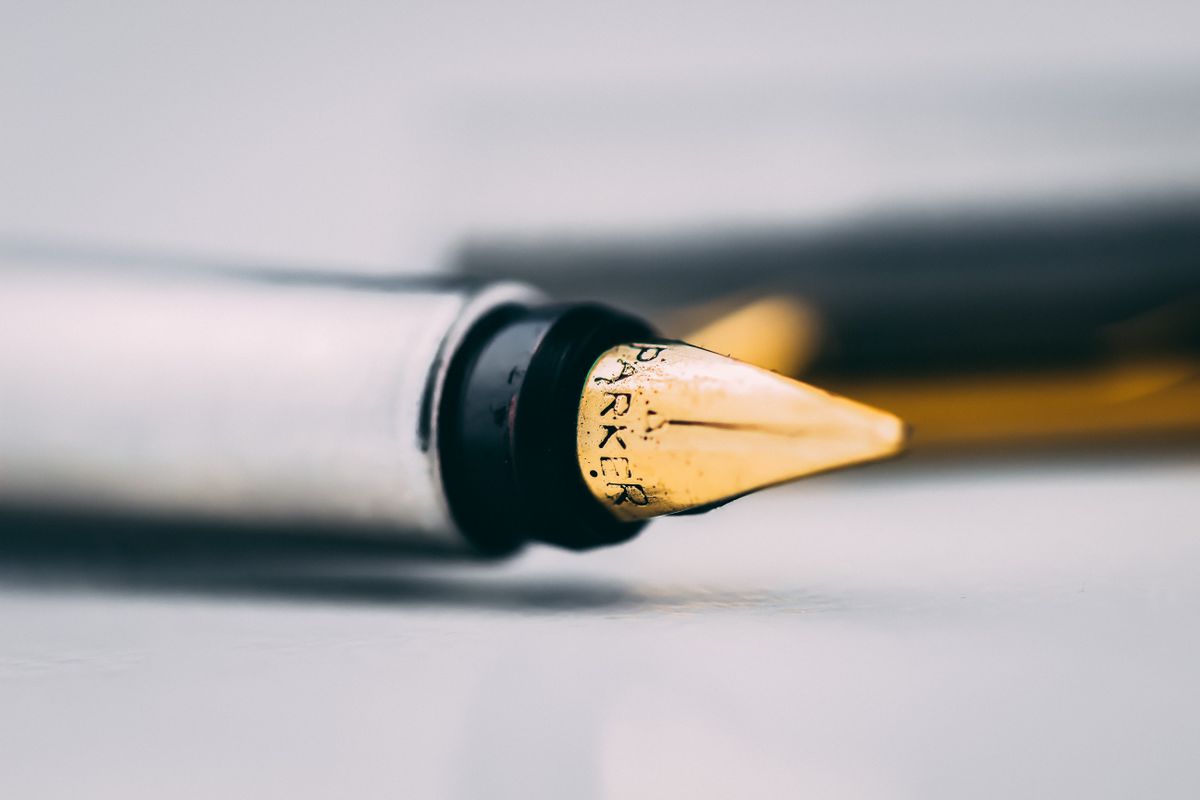
- Architecture: The nib shape is a classic two-tone gold with beautifully engraved scrollwork. The "1911" Sailor stamp from the brand's founding year is right there on the nib. It's a joy to look at.
- Crispness: Even the Medium nib has a defined edge. Japanese nibs are generally finer than Western nibs at the same size, so a Sailor M is a great daily driver. If you want a noticeably wetter, more expressive line, the Music (MS) nib is outstanding.
I've owned the pen for six months and used it almost daily. The nib has not needed any tuning. It came perfectly aligned out of the box. Sailor does quality control at home that other brands sometimes skip.
Writing Experience
Here's where the Sailor Pro Gear Slim really shines. The Medium nib on Tomoe River paper is a perfect combination. The ink sits on top of the paper without bleeding. The pen glides smoothly with just enough feedback to feel controlled. I wrote a full three pages of meeting notes without my hand getting tired, which is the gold standard for me.
On cheaper paper (think: standard notebook paper, copy paper), the experience is still good. The nib doesn't railroad or skip. The ink flow is a touch dry on the cheapest paper, but never to the point of being a problem. This is much better paper-versatility than something like a flex nib, which often needs fountain-pen-grade paper to work.
Dry time is average. Compared to a Pilot Metropolitan, the Sailor M is maybe a second slower to dry. Left-handed writers who push the pen across the page (sidewriters) will have a small smudge window. Pull-writers (underwriters) will be fine. If dry time is critical, pair the Pro Gear Slim with a fast-drying ink like Pilot Blue or Iroshizuku Ku-jaku.
The ink capacity from the converter is around 0.5 mL — that's about a third of the way to a full bottle of ink. If you write a lot, you'll refill once a week. If you're a heavy daily writer, you might want to grab a few extra cartridges. They hold about twice as much as the converter, and Sailor sells them in packs of six.
Pros & Cons
Pros
- Outstanding 14k gold nib — among the best you'll find at any price, period
- Lightweight resin body — comfortable for long writing sessions
- Multiple nib options — EF, F, M, MB, B, MS, plus specialty grinds
- Beautiful finish and detailing — Sailor polish is industry-leading
- Posts securely — the cap posts deep for a full-size feel
- Strong collector ecosystem — Sailor special editions hold value and are fun to chase
- Includes a converter — try bottled ink from day one
Cons
- Resin body feels light — if you prefer heft, look at the Pilot Custom 74 or Platinum 3776
- Proprietary converter/cartridge — not compatible with international standard
- Smaller than full-size pens — bigger hands may prefer the regular Pro Gear
- Special editions are expensive — $200–$280 vs $130–$180 for standard
- Limited availability in the US — relies on Amazon, Pen Chalet, or Japanese importers
- Cap takes 1.5 turns to remove — slightly slower than click pens or quick-release designs
Sailor Pro Gear Slim vs Pilot Metropolitan
This is the most common comparison, and it's worth a section. The Pilot Metropolitan is the gold standard beginner fountain pen at $15–$25. The Sailor Pro Gear Slim is roughly eight times the price. Is it eight times the pen?
No, it isn't. But it's clearly the better writing experience.
The Metropolitan's steel nib is genuinely good for the price. I've recommended it for years as the best first fountain pen. But the Sailor 14k gold nib, the way the ink flows, the way the tines give just enough feedback — it's a different category. Once you've written with a quality Sailor nib, the Metropolitan feels utilitarian.
Build-wise, the Metropolitan has a brass body and noticeable weight. The Sailor is lighter but feels more refined. The Metropolitan has proprietary cartridges (Pilot CON-50). The Sailor has Sailor proprietary cartridges. Neither is great. The Metropolitan comes in more colors and patterns. The Sailor comes in more interesting special editions.
My recommendation: If you've never owned a fountain pen, start with the Pilot Metropolitan. Once you know you enjoy the hobby and want to invest in a real gold nib, the Sailor Pro Gear Slim is the natural next step. It's a meaningful upgrade that you'll appreciate for years.
Sailor Pro Gear Slim vs Platinum 3776 Century
The other obvious competitor is the Platinum 3776 Century, which sits in the same $130–$180 price range. Both are Japanese, both have gold nibs, both are excellent. How do they compare?
The 3776 is larger and heavier (about 22 grams vs 17 grams). It has a built-in slip-and-seal cap that prevents the ink from drying out for over a year — genuinely useful for an EDC pen. The 3776 nib is famous for its fine-tip precision and a slightly smoother, wetter feel than the Sailor. The Platinum nib is softer, the Sailor nib has more feedback.
Style-wise, the 3776 is a more conservative, classic cigar shape. The Pro Gear Slim is more modern with its flat ends and faceted cap. It's a preference thing.
The 3776 wins on paper endurance (cap seal) and nib smoothness. The Pro Gear Slim wins on nib feedback, special edition variety, and pocketability. I own both. If I had to pick one for daily carry, I'd take the Pro Gear Slim. If I had to pick one for the desk, I'd take the 3776.
Honestly, you can't go wrong with either. Pick the one whose design speaks to you.
Who Is the Sailor Pro Gear Slim Best For?
- Stepping up from a beginner pen — the most natural next fountain pen after the Pilot Metropolitan or Lamy Safari
- Daily writers who don't want a heavy pen — the resin body is comfortable for long sessions
- Nib enthusiasts — Sailor nibs are widely considered the best in the world
- Collectors — Sailor releases stunning seasonal and special editions throughout the year
- Journalers — the nib feedback is ideal for sustained writing without fatigue
- Anyone who wants a real gold nib under $200 — it's the price-to-quality sweet spot
It's not ideal for left-handed sidewriters who need fast dry times (consider the Pilot Metropolitan with a dry ink instead), or for people who prefer heavy, substantial writing instruments. It's also not the best "first fountain pen" — you'll appreciate it more after you've used a steel-nib pen for a while.
Best Inks to Pair With It
One of the joys of a Sailor pen is that Sailor also makes one of the best ink lines in the world. The proprietary Sailor ink bottles are gorgeous, but the standard converter works fine with any bottled ink. Here are my top picks:
- Sailor Manyo Akebi — a deep purple-black that looks gorgeous on cream paper. This is the ink that made me fall in love with Sailor pens.
- Pilot Iroshizuku Kon-peki — a vivid cerulean blue. Smooth-flowing, well-behaved, and pairs well with the Medium nib.
- Sailor Shikiori Yozakura — a soft cherry-blossom pink. Perfect for letter writing and journaling.
- Platinum Carbon Black — a waterproof pigment ink. Bulletproof for mailing or scanning.
- Sailor Sei-boku — a dark teal with a slight green sheen. Hidden gem.
These are all bottled inks. A single bottle (30–50 mL) will refill your Pro Gear Slim 60–100 times. The cost per refill is cents, far cheaper than cartridges in the long run.
Final Verdict
The Sailor Pro Gear Slim is, in my opinion, the best mid-range fountain pen on the market. It hits the sweet spot between price, performance, and prestige. The 14k gold nib is exceptional — I'd put it against nibs costing twice as much. The resin body is well-executed and comfortable. The special edition catalog keeps the hobby interesting. It's the kind of pen that makes you want to write more.
If you already know you enjoy fountain pens, the Pro Gear Slim is the next pen you should buy. If you're new to the hobby, start with the Pilot Metropolitan and graduate to the Sailor when you're ready. Either way, you'll be writing with a pen that punches well above its weight.
Rating: ★★★★½ (4.5/5)
The half-star deduction is purely for the proprietary converter and the price jump from entry-level pens. Neither is a deal-breaker. The pen itself is gorgeous.
Check Latest Price on Amazon →Keep reading: If you're building a Japanese fountain pen collection, check out our full guide to Japanese fountain pens and our Platinum Preppy review for a sub-$10 option to round out your rotation.